Later this week, I’ll be off to the four-yearly conference of Syriac Studies in Bucharest, organized in conjunction with the conference for Christian Arabic Studies. The program is exciting: a great variety of topics that show how the two interconnected fields have considerably expanded over the past decades – not only as to topics but also as to the wide range of contributors from all over the world.
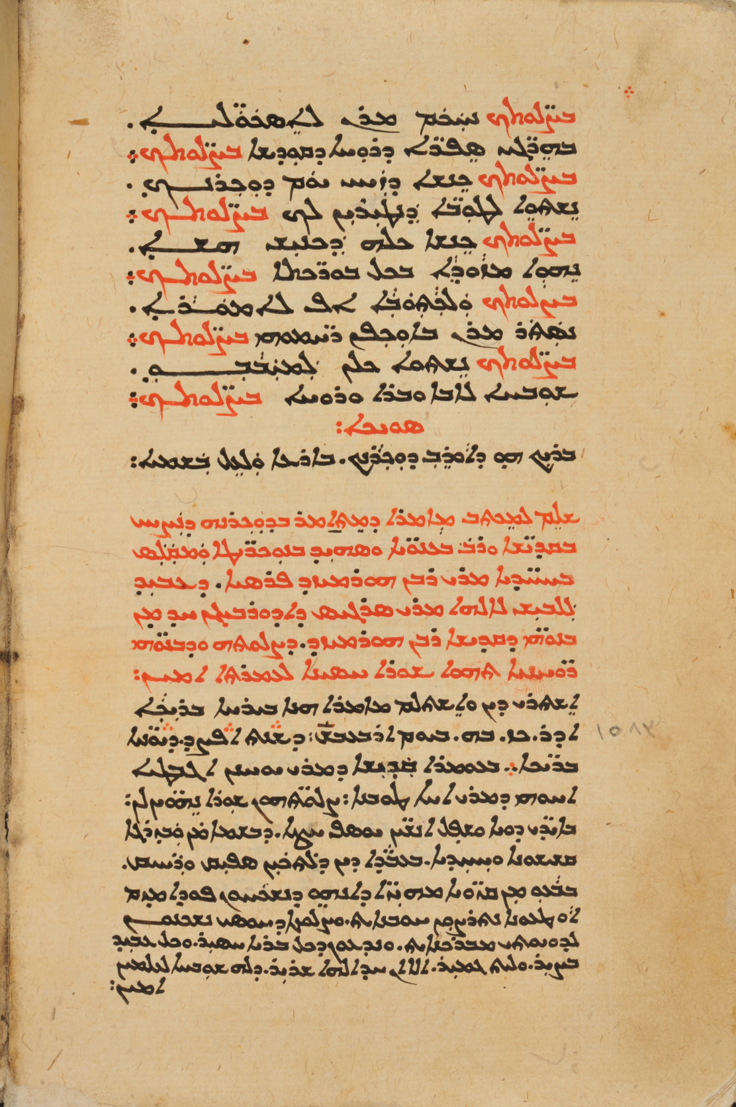
During the conference, I will update my colleagues about a manuscript that I came across almost ten years ago, when it had recently been digitalized by the Hill Museum & Manuscript Library (HMML) (for the manuscript, CCM 398, see the HMML Reading Room). The manuscript, dated to the year 1583, provides us with the fascinating perspective of an East Syriac monk on the world of his day; a monk in a remote monastery, near today’s Cizre on the Tigris, in Eastern Turkey, far away from the metropolises of the day. This was the time when the Ottoman and Safavid Empires stabilized, and when the Roman Catholic Church – embattled and reduced by the Protestant Reformation – sought to extend its influence elsewhere – in the America’s, in Sub-Sahara Africa, in India and China, and in the Middle East.
Yawsep’s monastery, the monastery of Mar Yoḥannan the Egyptian, belonged to the Church of the East (today’s Assyrian Church of the East). This church, after almost two centuries of isolation, from about 1500 onwards had started to be interested in new connections, with India, with Russia, with the Levant and with Europa – especially with the Catholic Church. Some clerics had gone as far as to have themselves consecrated in Rome, to oppose what they thought were uncanonical consecrations among the leadership of the Church of the East. The first of these was Mar Yoḥannan Sullaqa, who was confirmed as (counter) patriarch by Rome in 1553. This moment can be seen as the (very modest) beginning of what was to become the Chaldean Church in union with Rome, until today the largest church in Iraq.
Already in the thirteenth century, the Church of the East was in touch with the Roman Catholic Church, with the help of two Chinese monks.[1] These early contacts were fairly uncontroversial. Indeed, most theologians saw the church led from Rome as the legitimate heir of the ancient patriarchate of Rome, which was considered the “first among the patriarchates”. However, to most clerics involved, this did not automatically mean that their church should become part of the Catholic Church, or that the Pope in Rome should decide on internal matters of the Church of the East. All of this could easily be the consequence of Sullaqa’s consecration and the separate “Chaldean” hierarchy that resulted from it. This was indeed controversial, among clerics in the Church of the East, and among the worldly authorities in the Ottoman Empire who were weary of the potential political implications of their local churches submitting to the major church of the West.
This manuscript from Gazarta in 1583 positions itself right at the heart of these discussions and controversies, though never spelling that out. In fact, it is entirely conjectural whether or not the manuscript was explicitly meant as a contribution to the discussions of the day. However, my initial analysis of what we know about the scribe, his context, and about the texts that he included in his compilation, suggest that Yawsep knew very well what was going on, and that his collection reflects what he thought would contribute to the debates of his day – for himself and for his fellow monks. Many of the texts he collected are as yet not fully studied, but a few of my initial conclusions can be shared already.
The monk and priest Yawsep worked in the monastery of Mar Yoḥannan the Egyptian, close to its twin monastery Mar Aḥḥa, “the natural brother of Mar Yoḥannan”. For all that we know these two monasteries firmly belonged to the party of those who advocated the traditional independence of the Church of the East. Unfortunately, the manuscript lost its final pages, which is where the scribe would usually state his allegiance to a certain patriarch and bishop. However, other manuscripts, written in the same period in the same monastery, confirm its allegiance to Mar Eliya bar Giwargis (1558/9-1591), the traditional patriarch who at that time had his see in Rabban Hormizd. In addition, there is another manuscript that perhaps can be ascribed to the same Yawsep, written in 1569 in the same monastery. Here Yawsep explicitly claims allegiance to Mar Eliya bar Giwargis.[2]
This traditional monk, in a traditional monastery, wrote a codex that in many ways was not traditional at all. This is true for the set-up: the codex includes a unique combination of different texts that do not have any obvious thematic or liturgical connection. This differs from the vast majority of East-Syriac manuscripts of the Ottoman period, which usually are put together for specific liturgical use during daily or weekly prayers, or would be organized around a specific theological theme, or as a collection of works from a specific author. This manuscript lacks such obvious coherence. A few of such eclectic collections are due to later users, who had certain older texts bound together, perhaps catering to their specific wishes, or merely to protect smaller pieces of older manuscripts in a new sturdy binding. In this case, however, the regular handwriting throughout the codex and the way the texts follow upon each other, suggests that the contents of the codex were indeed put together deliberately, not incidentally bound together.
This bulky volume of 345 folios (690 pages) of mostly Classical Syriac texts includes up to eighty different texts, varying from brief to very long poems, and from riddles of a few lines to theological and historical treatises of ten to twenty pages (I hope to write more about its contents later). The two longest pieces speak explicitly to Yawsep’s monastic world. The longest (133 pages) is Sargis bar Wahle’s commemoration of Rabban Hormizd the Persian – the founder of the monastery where the leader of the traditional party had taken up residence, and where Sargis was a monk, probably in the early sixteenth century. This long memra (poem) is preceded by another popular memra (74 pages), “on theology and perfection”. This memra originated in a poem by the thirteenth-century Syriac Orthodox church leader and polymath Grigorios bar ˁEbroyo (Barhebraeus) but which was expanded by later authors from the Church of the East. Like the poem on Rabban Hormizd, this too expands on monastic and ascetic themes.
The third major part of the manuscript is taken up by the poetry of Yawsep’s near contemporary ˁAbdishoˁ of Gazarta. In fact, this manuscript is one of the most important sources of ˁAbdishoˁ’s work. In total, about 170 pages (interspersed with other texts) are devoted to poetry from this author.
This ˁAbdishoˁ of Gazarta (d. 1570) is a fascinating figure, who deserves a blogpost of his own (luckily recently Anton Pritula’s full length study became available!). Most importantly for my point today, however, is that contrary to the other authors mentioned so far, ˁAbdishoˁ was firmly in the Catholic camp. He had succeeded Yoḥannan Sullaqa, he travelled to Rome in 1562, he wrote a hymn on how Sullaqa became a martyr, and he eulogized the Pope. It is, therefore, rather remarkable that his poems are so prominent in Yawsep’s collection.
There might be several reasons for this. One is that it is highly likely that the two men knew each other – ˁAbdishoˁ had been trained initially in Yawsep’s monastery, and the monastery where ˁAbdishoˁ took up residence after he became patriarch (Mar Yaˁqub Ḥbishaya – ‘Jacob the Recluse’) was not far away. Two, most of his poetry in fact has little to nothing that makes them particularly Catholic. The inclusion of his poems in this collection and in other manuscripts both in this period and later, suggests that ˁAbdishoˁ’s poetry was appreciated in Catholic and non-Catholic circles. Which ties in with the third point, building upon Lucy Parker’s work: there might not have existed such strong boundaries between the two parties as both researchers and church people thought earlier.[3] Indeed, Yawsep included ˁAbdishoˁ’s eulogies on “the pope in Rome”, apparently seeing no contradiction here with his own perhaps more traditional context.
Whereas for some these fluid boundaries might have been something to work around, not caring too much whether someone belonged to the one or the other party, some of the other texts in this volume suggest that for Yawsep this was not the case. Many of the texts he included speak to the contentious topics of the day – about the hierarchy of patriarchates, about patriarchal elections, about marriage law, about setting the Easter date and about calendars more generally, about the history of the Church of the East in relation to the Syriac people, and about the Syriac people in relation to the people in the bible. All of these themes – even if solidly grounded in the theological history of the Church of the East – were part of the discussions put back on the table by the encounter with the Roman Catholic church: is there one patriarch ruling over the others, or does the church divide power regionally? Who is elected lawfully and who decides on civil matters in the church? What calendar do we follow? (Note that a year earlier Pope Gregorius had introduced the calendar reform).
Perhaps Yawsep was building his own little library of relevant texts for the discussions of the day, discussions that probably also took place in the monasteries, among the brothers. Yawsep, it seems, was not yet willing to choose, taking his time to study and learn from what earlier authors – from his own party, from the new Catholics, from the Syriac Orthodox Church – might have to say about this. His “Book of the Garden” contains many beautiful flowers, some neatly arranged in flowerbeds, others seemingly randomly sown in between – there is some system in his learning, but at the same time it seems to be eclectic and open to the new. And quite likely, when we will study this collection in more detail, we will get a better sense of where he was going.
[1] See the intriguing story of two monks from China who went to Iraq where they were elevated to high office, one to the patriarchate, Mar Yabhalaha, and one as his major representative, Rabban Sauma, who was then sent on a diplomatic mission to Europe. For the full text, translation and introduction, see Pier G. Borbone, History of Mar Yahballaha and Rabban Sauma (Hamburg 2021); for a quick overview, see my “The Church of the East in Mesopotamia in the Early Fourteenth Century”.
[2] Diyarbakir 59; cf. Addai Scher, “Notice sur les manuscrits syriaques et arabes conservés à l’archevêché chaldéen de Diarbékir,” Journal asiatique 10/10 (1907), 331–362, 385–431 (here: 357–359).
[3] See her 2022-article “On the Margins of Empire: Confessionalization and the East Syriac Schism of 1555” in Krstić & Terzioğlu (eds.), Entangled Confessionalizations?
 Globalization, Christianity and the Middle East