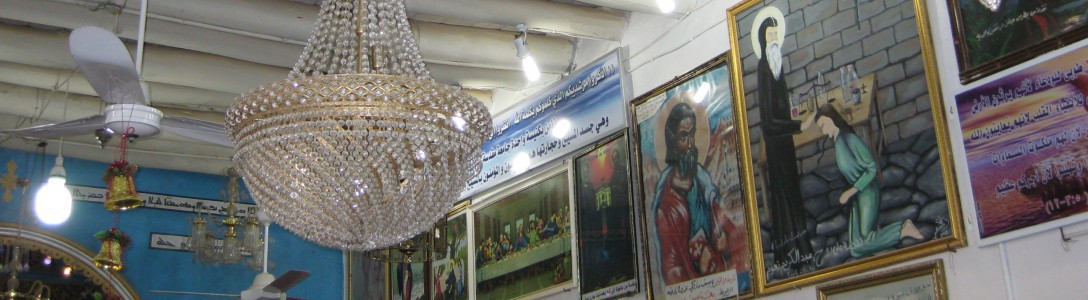
Among the courses I teach, two relate particularly to global and transnational Christianity/ies, one in Dutch (BA level) and one in English (MA level). These two courses are open to those not enrolled in our programs (note that the second course is a master course and requires a BA degree in the humanities or social sciences). As of September 4, the Dutch course on christendom has been booked full. The course on The Syriac World is still open, because we’ve re-scheduled it – from onsite to online, and from Wednesday morning to Tuesday evening (7.30-9pm), starting on September 29. So you can still join! If and when you’re interested, send me a message.
1/ Global Christianities: The Syriac World (MA, English)
In this course we study contemporary global Christianity from the perspective of the Syriac tradition: all those Christians that in a surprisingly varied way feel connected to a strand of Christianity that through almost two thousand years understood itself primarily through the Syriac language – in its classical form (‘Classical Syriac’) and modern day vernaculars (Sureth, Surait). The majority of these churches and communities belong to the Orthodox tradition (Syriac Orthodox, Assyrian Church of the East), other parts have joined the Catholic Church (Maronites, Chaldeans, Syriac Catholic, Syro Malabar). A small part has joined various Protestant communities, including Presbyterian and Pentecostal strands. As important for the study of global Christianity, these communities are found in all parts of the world – in the homelands in the Middle East and South India, in Africa, in North and South America, in Australia and in Europe – showing the diversity of Christian inculturation around the world, as well as the ongoing interactions and entanglements of Christianity worldwide, within transnational denominations as much as between these various groups.
For the ‘Syriac world’ (as much as for ‘Christianity’ as a whole) this also poses the question as to what it is that binds them over denominations and regions. In tackling this question, not only matters of religious thought and practice in the narrow sense play a role, but also issues of language, ethnicity and nationalism, showing how religion – among Syriac Christians as much as among others – always is closely related to what we tend to see as distinct parts of cultural behaviour, such as politics, art and language.
As a starting point, we use the great book by Françoise Briquel-Chatonnet and Muriel Debié, The Syriac World: In Search of a Forgotten Christianity (2023).
2/ Christendom (BA1, Dutch)
In deze cursus bestuderen we hoe het wereldwijde christendom eruit ziet en waar de huidige verschillen en overeenkomsten binnen deze zeer gevarieerde religie vandaan komen.
We bespreken daarbij (aan de hand het boek van Douglas Jacobsen, The World’s Christians. Who they are, Where they are, and How they got there, 2021, 2de druk) eerst de verschillende grote tradities (orthodoxen, katholieken, protestanten, pentecostalen) en de grote lijnen van de geschiedenis waarin deze grote tradities zich ontwikkelden. Daarna zoomen we in per regio, waarbij we veel aandacht aan lokale culturele, religieuze, sociale en politieke omstandigheden die helpen om de verschillende varianten van christendom in hun eigenheid te begrijpen. Hierbij gaan we op zoek naar de vraag hoe thema’s van het wereldwijde christendom (en voor de wereld waarin dit christendom zich verder ontwikkelt) ook vandaag van belang zijn. Die hebben vaak te maken met de relatie tot andere varianten van religie, de relatie van religie tot de politieke macht, en de houding van kerken en christenen in discussies over seksualiteit, relaties en levensbegin en levenseinde.
In deze brede inleiding tot het wereldwijde christendom besteden we ook regelmatig aandacht de bronnen waarop onze analyse gebaseerd is: waarop baseren we historische kennis? Wie heeft de beschikbare bronnen geschreven en verzameld? Hoe beoordelen we de informatie in een krantenartikel? Hoe kom je tot betrouwbare informatie over aantallen en geloofsovertuigingen? Welke vooronderstellingen spelen mee bij de auteurs van de bronnen, bij degenen die onderzoek doen naar christelijke gemeenschappen, en bij de lezers van deze teksten, inclusief wijzelf? Hoe kun je goede kennis over religie vergaren? En hoe schrijf je daarover?

